

 ToolMod Pro Audio ToolMod Pro AudioM/S Matrix TM130 The M/S matrix with Stereo Base and Direction Controls for Mastering and Recording with Stereo Microphones in M/S Mode. The M/S Matrix TM130 is best suited for the influencing of the stereo base width and direction with stereo mastering and mixing and stereo recordings with stereo microphones in M/S mode. Format conversion of standard stereo signals in left - right format to M/S and vice versa is also possible with the TM130. The controls offer access to the stereo base width and direction. The feature set includes an elliptic equalizer. The TM130 M/S Matrix comes with appropriate control ranges for recording, while the TM130m is best suited for stereo mastering and mixing. Mastering Set M/S - M/S Microphone Set - M/S Processor |
Highlights:
all M/S Modules:
Alternatives:
|
|||||||||||||||||||||||||
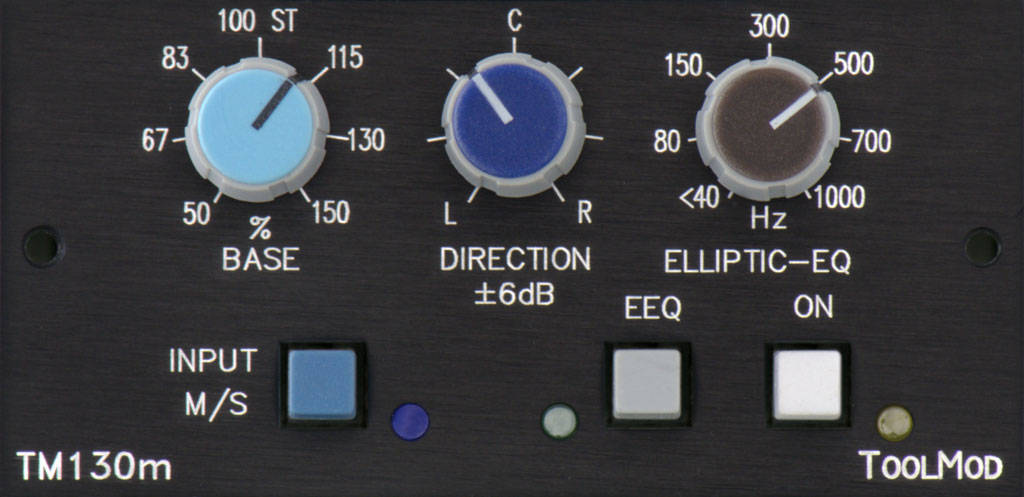 M/S Matrix with elliptic EQ for Stereo Mastering
 |
||||||||||||||||||||||||||
|
Stereo Mastering and Mixing
When using the M/S matrix for mastering and mixing,
the spatial image of the stereo signal can be controlled effectively. The BASE
control alters the width of the stereo image from 50 % up to 150 % enhanced
base width. The 100 % position has a center detent and is precisely calibrated.
Stereo base enhancement in the range from 100 % to 150 % can improve the character
of a stereo mix in a unique way. Depending on the structure of the mix, not only
the stereo base is extended over the speakers but also three dimensional effects
are possible. The mix seems to fill the space behind the stereo base line. Using
such settings will also result in a different level balance between the channels;
the direction control can be used to readjust identical levels in both stereo
channels. The reason for the different levels is easy to understand. If a particular
signal is located at the position 50 % to the right, it moves more to the right
when the base control is set to more than 100 %. Apart from different phase relations
between the channels also the level relation between the channels must change
to achieve the enhancement, depending on the structure of the mix and the setting
With all base settings above 100 %, signal components of the right channel are increased on the right channel and reduced on the left channel as far as level is concerned. In addition, phase reversed signal components of the right channel appear in the left channel. The mono compatibly is the most critical issue using enhanced base width. When adding both stereo channels to mono all out of phase signals in both channels will be attenuated the more, the better the levels in both channels match. It is essential to check the mono signal after every change of the settings extensively when using this very interesting effect. elliptical Equalizer
The elliptical Equalizer allows in some extend compensating the out of phase side effects. This device can be considered as some sort of frequency depending mono matrix that reduces the base width towards low frequencies with a steepness of 6 dB/oct. The human ear cannot locate any frequency below 300 Hz. The distance of the ears in combination with the reaction time of the brain determines this limit, since the wavelength of a 300 Hz signal is so long that the difference in level and time between the ears is not perceptible. In addition to this effect, a level difference of more than 15 dB in both stereo channels results in the effect that the signal is located from the one side only. This means that human ear cannot hear any difference between only one channel active and a level difference of 15 dB in the stereo channels. Of course, there are little, individual differences; someone may hear a difference of 1 or 2 dB more or less but this does not matter that much. Setting a crosstalk of 15 dB at 300 Hz that increases towards low frequencies will not result in audible differences as far as the location is concerned. However, such a setting reduces the base width of low frequency signals considerably and maintains a solid, centered bass fundament that reduces the mono compatibility problem when using stereo base enhancement. The elliptical equalizer of the TM130 M/S Matrix has a center detent at the 300 Hz / 15 dB crosstalk position, the control range is from less than 40 Hz up to 1000 Hz. Settings above 300 Hz may be audible; however, such settings can result in a good compromise between enhanced stereo and mono compatibility.
How the Direction Control works
The direction control of the matrix operates not in the way of a conventional pan pot or stereo balance control that cuts off one channel with settings all to the left or all to the right. Since the direction control operates in the M/S chain of the device, a setting all to the left results in a mono signal on the left channel only. Both input signals are always present; however, the relation between the output channels is changed. On the way from the center position to the left, the base width is reduced more and more and the right channel is attenuated while the right channel input signal is mixed to the left channel output.
Recording with Stereo Microphones in M/S Mode
Together with two mic pre's, the TM130 M/S Matrix can be used for recordings
with stereo microphones in M/S mode. The input mode select switch INPUT M/S
changes the behavior of the input stage to accept M/S format signals instead
of left/right signals. The outputs of the two mic-pre's are connected to the
inputs of the matrix. The controls of the matrix make possible to modify base
width and direction of the stereo signal as usual; the elliptical equalizer can
also be used. The output stage converts the signal into the left/right format.
Recording Version vs Stereo Mastering Version
Using the M/S Matrix for recording with stereo microphones is of course possible
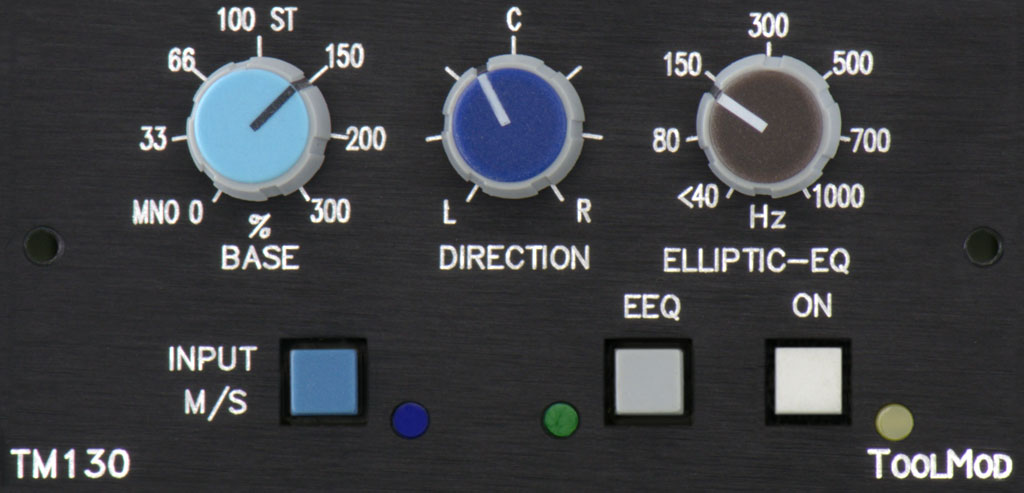
with both versions of the TM130; however, the recording version TM130 offers
wider control ranges for the BASE and the DIRECTION control. While the 'm' version
for stereo mastering comes with control ranges that are useful for that purpose,
the recording version TM130 offers a control range from 0 % stereo = mono to
300 % stereo. The direction control of the mastering version has a range of +/-
6 dB which is appropriate for correcting the differences of the channel balance
when using base setting of more 100 %, while the recording version comes with
a range from 'mono to left channel' to 'mono to right channel'. Both versions
have a calibrated center click for the BASE and the DIRECTION control.
Format Conversion from L/R to M/S and vice versa
In addition to the conversion from M/S to left/right it is possible to use the
TM130 to convert left/right stereo signals into the M/S format. The internal
matrix is designed in a way that it works in both directions, M/S to L/R and
L/R and M/S. However, when using the unit to convert L/R to M/S the base and
direction controls have to be in their center positions and the elliptical equalizer
cannot be used. These controls are still functional but while converting L/R
to M/S they are not useful for anything. Actually, the base control will alter
the right channel level, while the direction control changes the level balance
between the left and the right channel. If these controls are in the center positions
the matrix simply converts the left and right input signals into corresponding
M and S output signals. Using two TM130 units offers the opportunity to have
the signal in M/S format available for processing with equalizers and dynamics.
The second M/S matrix reconverts the processed signal back to left/right. Since
the controls in the second unit are fully functional, access to the base width
and direction control is possible. The ToolMod MS-Processor combines two TM130 with eq's and dynamics.
The L/R M/S Matrix TM131 is the better choice for a simple conversion from or to M/S without additional features.
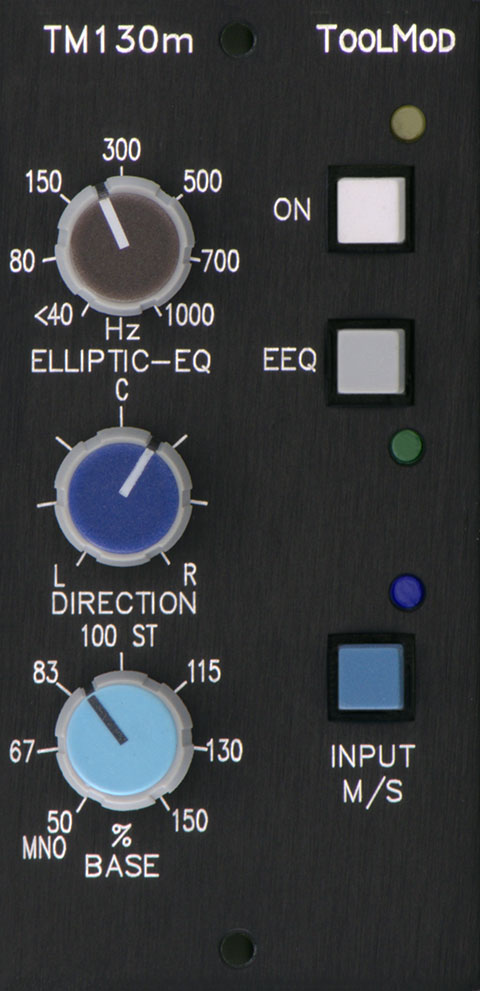
Both versions of the TM130 M/S Matrix are 2U ToolMod modules that fits into all available ToolMod Frames. As usual, horizontal and vertical versions are available. |
|
|||||||||||||||||||||||||



 ToolMod Manual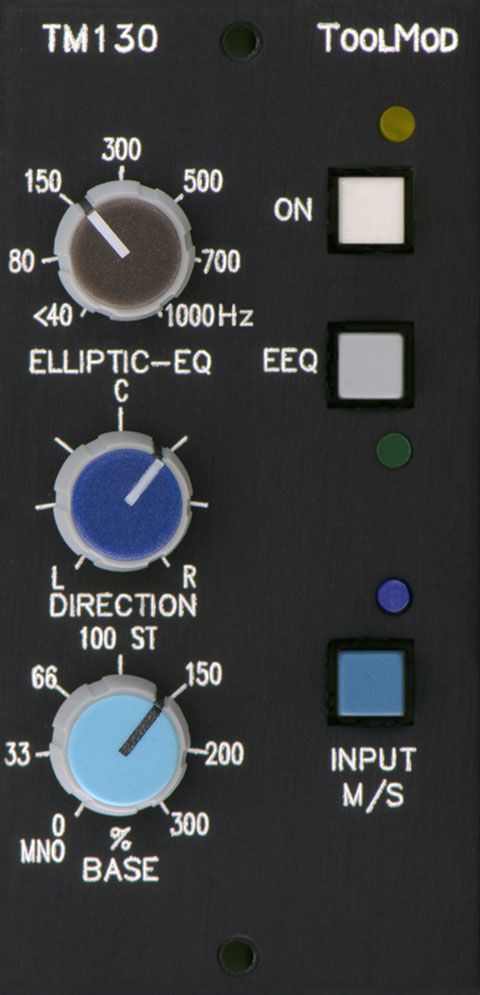
 0049 2043 51061 0049 2043 51061Callback Service |
|
| Newsletter |
| Where to buy | |||
| Support | |||
| Download | |||
| Tell A Friend | |||
Imprint
|
transformer Mic Pre TM102
discrete Mic Pre TM103
active DI Amp TM105
5-Band Equalizer TM107
3-Band Equalizer TM112
Compressor TM112b
VCA Compressor TM115
Brickwall Limiter TM115b
Peak Limiter TM116
Noise Gate TM130
M/S Direction Mixer TM131
L/R-M/S Matrix TM132
M/S Compressor TM133
M/S Mastering EQ TM134
4-Band M/S EQ TM204
4-Band Mastering EQ TM205
5-Band Stereo EQ TM212
Stereo Compressor TM212b
Stereo VCA Compressor TM215
Stereo Limiter TM215b
Mastering Limiter TM222
Mastering Compressor
ToolMod Sitemap