

 |
|
 ToolMod
M/S Recording Set ToolMod
M/S Recording SetThe ToolMod M/S Stereo Recording Setis a complete frontend for recording with all kinds of stereo microphones. A matched pair of TM101 Mic Pre's is used as stereo input amplifier. Due to the integration of the M/S matrix TM130, microphones in M/S mode can be used as well. The set is completed with the special M/S EQ TM134 for frequency dependent base width control. The M/S stereo recording set allows adjustments of the spatial image with the base width and direction controls of the M/S matrix that includes an elliptical EQ and the M/S equalizer. The Set is also well suited for stereo mastering. |
Highlights:
Modules for the
M/S Recording Set: |
 0049 2043 51061 0049 2043 51061Callback Service |
|

It is obvious that the ToolMod system
can be used to combine any kind of modules in any desired way. The ToolMod sets
are some examples of special setups for a particular application. The picture
shows a ToolMod M/S stereo recording set with two mic pre's, M/S matrix and
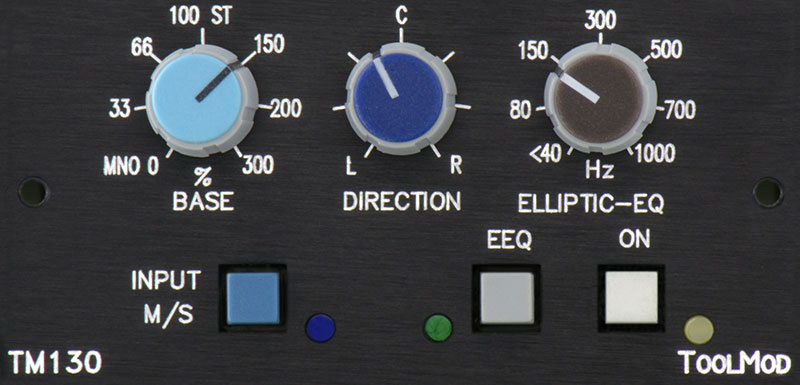
M/S equalizer.The M/S Mic Pre with Equalizer ToolMod MMVThe ToolMod MMV is a very special combination for recording with stereo microphones. It combines a matched pair of mic pre's, a M/S matrix with stereo direction mixer and elliptic equalizer, and a 4-band M/S stereo equalizer. In addition to the common stereo recording modes, the coincidence stereophony and the spaced-apart stereophony, the ToolMod M/S Microphone Pre-Amp can also deal with microphones in M/S setup, which is considered as the best way for stereophonic microphone recording by many specialists. The spaced-apart stereophony uses two separate microphones, placed on the left and right side of the sound source. The implementation of this principle is easy; no special microphones or other special equipment are needed. It offers an easy way for wide and deep sounding stereo recording; however, the distance between the microphones causes a frequency dependent phase difference between the channels, which results in low mono compatibility and in the need to adjust the microphones with consideration to the mono compatibility carefully. Coincidence stereo does not have these problems. Usually, a stereo microphone is used. The distance between the two capsules is very low; both capsules are cardioids, arranged at an angle of approximately 90 %. The small distance between the capsules results in negligible phase shift. The location of the sound signals is only based on the intensity relation of the stereo channels. The disadvantage of this principle is the frequency dependence of the directional characteristics. Cardioid microphones change the form of the characteristics with the frequency. With high frequencies, the characteristics is narrow. This causes a loss of high frequencies for the signals at the center. The M/S principle uses the two capsules of a stereo microphone differently. One capsule is set to cardioid mode and directed to the center of the sound source. This microphone represents the mono signal. The second microphone is set to bidirectional characteristics; the 'figure-eight-pattern' is arranged at an angle of 90°. A signal in the center will not result in an output signal of the bidirectional microphone that represents the S channel. Since both sides of the bidirectional mic are out of phase, a sound source on the left side results in a signal that is in phase with the M channel while a sound source on right channel is out of phase. Such a microphone setup delivers a M/S output signal instead of left and right. Since the cardioid is directed to the center of the sound source, there is no loss of high frequency in that area. The disadvantage of this principle is that the output signal of the microphones must be converted by a matrix from M/S format to left & right standard stereo format. Here is information on the L/R - M/S Conversion Basics. The INPUT M/S switch of the TM130 M/S matrix takes care about that. The unit also includes controls for the stereo base width, including a huge stereo enhancement range, M/S based direction control as well as an elliptic equalizer. Read about the details of these control on the TM130 M/S Matrix page
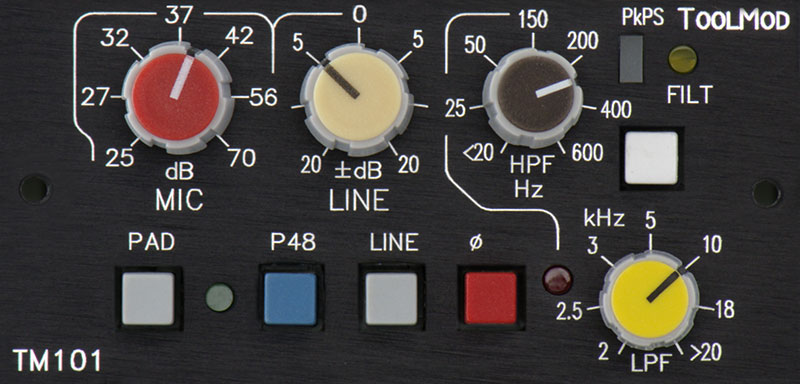
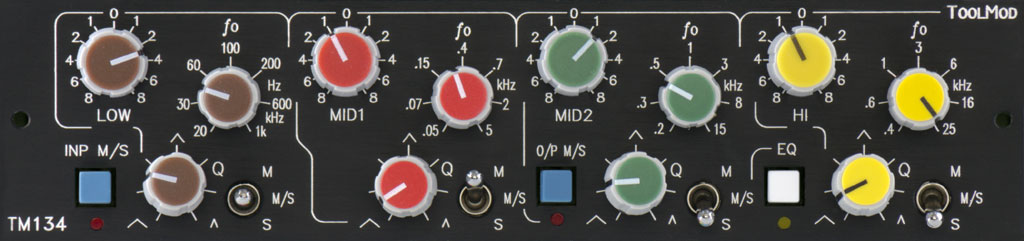
A matched pair of TM101 Transformer Mic Pres is used as input amplifiers. The M/S microphone Preamp is completed by the TM134 M/S Stereo Equalizer, that allows frequency dependent base width modification. Here is basic information on M/S Equalization
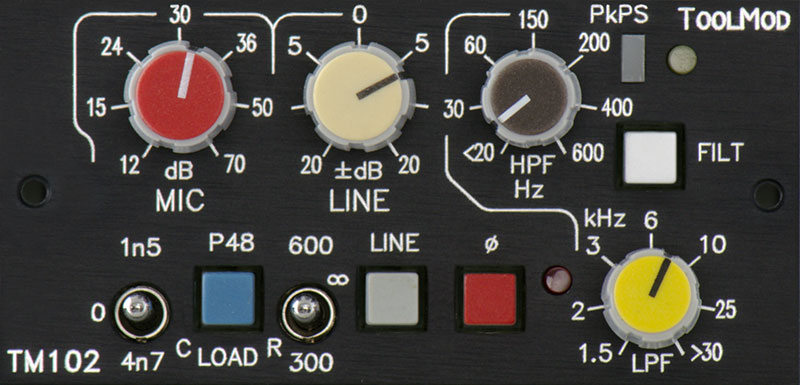
Instead of the TM101 transformer Mic-Pre, a matched pair of the discrete Mic-Pre TM102 can be installed. The TM134 MS-Equalizer can be replaces by the TM222 Stereo Mastering Compressor or by the TM132 M/S Stereo Compressor. In combination with the TM212 Stereo Compressor, an additional TM215 oder TM215b Stereo Limiter instead of the TM134 M/S EQ is possible as well. |
Other ToolMod Modules for the M/S Mic-Preamp:
TM102 discrete Mic-Pre
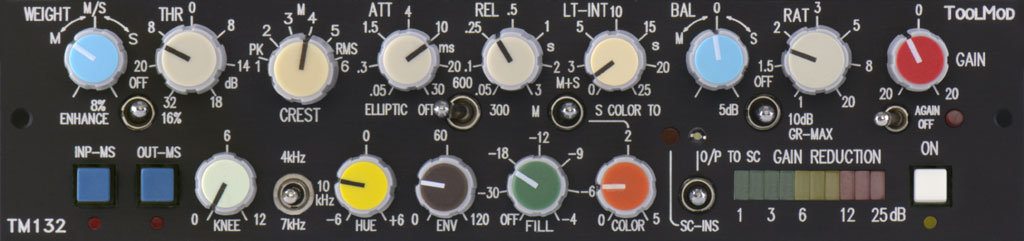
TM132 M/S Mastering Compressor
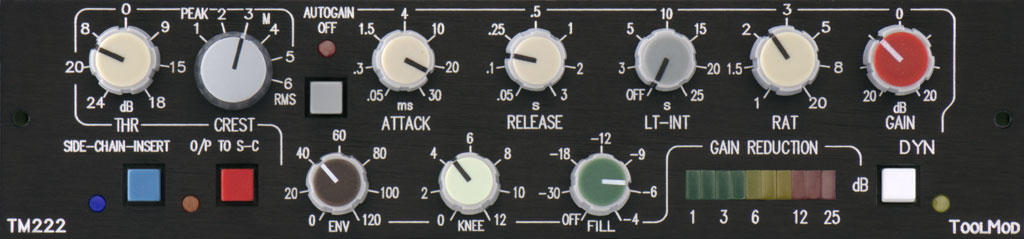
TM222 Stereo Mastering Compressor
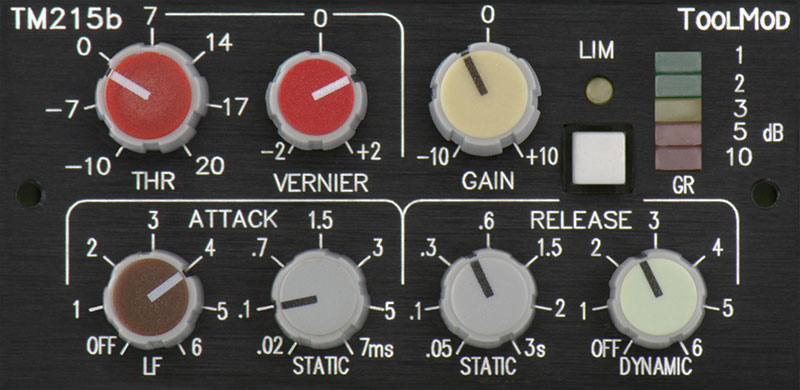
TM215b Stereo Peak Limiter
TM212 Stereo Compressor |

| SURROUND SOUND |
| MIXING CONSOLES |
| Newsletter |
| Where to buy | |||
| Support | |||
| Download | |||
| Tell A Friend | |||
Imprint
|
| The ToolMod stereo mastering modules use many of the special circuitries that have been developed and optimized for the V700 mastering gear. They offer important features of this module system that has been designed especially for mastering studios. Due to the construction principle of the ToolMod system without extensive and expensive mechanics, fancy knobs, massive, machined faceplates and stainless steal housings along with higher production quantities result in the plain appearance of a normal console but make possible to offer a complete stereo mastering setup with compressor, equalizer and limiter at a price that is lower than a single module of the V700 series. |
transformer Mic Pre TM102
discrete Mic Pre TM103
active DI Amp TM105
5-Band Equalizer TM107
3-Band Equalizer TM112
Compressor TM112b
VCA Compressor TM115
Brickwall Limiter TM115b
Peak Limiter TM116
Noise Gate TM130
M/S Direction Mixer TM131
L/R-M/S Matrix TM132
M/S Compressor TM133
M/S Mastering EQ TM134
4-Band M/S EQ TM204
4-Band Mastering EQ TM205
5-Band Stereo EQ TM212
Stereo Compressor TM212b
Stereo VCA Compressor TM215
Stereo Limiter TM215b
Mastering Limiter TM222
Mastering Compressor
ToolMod Sitemap